Maritime Simulation Solutions
Automatic Identification System (AIS) Simulation
Working in conjunction with the US Coast Guard, BCG has developed an AIS message generator which is integrated into our MaST user interface. The simulated AIS messages can be output via a serial stream (RS232 or RS422), network UDP packets, or a network TCP stream. BCG’s implementation of the AIS data packet generation is done in compliance with the ITU-R M.1371-5, IEC 61993-2, IEC 61162-1 and NMEA-0183 standards.
A simulation exercise may include up to 1000 targets, each having defined AIS information. A library feature is provided for quick retrieval and storage of AIS information, and MaST supports entering large numbers of targets using a Comma Separated Values (CSV) file.
The MaST may also receive AIS messages via serial or network and includes the parsed information in an AIS message log window and log file. Text messages (SRM or Normal) can be sent/received and are logged in a separate text message log window.
The following AIS message types can be sent/received: 1, 4, 5, 6, 8, 9, 12, 13, 14, 18, 19, 21, 24, 25, 26, 27. The following AIS message types can be received only: 2, 3, 7, 11, 20.
For each vessel in an exercise, instructors can define both static AIS data (ship name, call sign, navigational status, MMSI and IMO numbers, destination, vessel dimensions, type of ship, cargo type, ETA, and more) and the simulator automatically generates the dynamic data (position, speed, course, heading, rate of turn, and timestamp) as the vessel moves. AIS can also be configured for Class A or Class B equipment types, for aircraft (generating SAR Aircraft position reports), and for Aids-to-Navigation (ATON) or Base Station entities. Position reporting intervals adjust automatically based on each vessel’s speed and course changes, consistent with international AIS specifications. To support realistic training scenarios, instructors can also introduce AIS failures, such as erroneous data fields, missing message updates, or position errors, and can enable or disable AIS output per vessel.
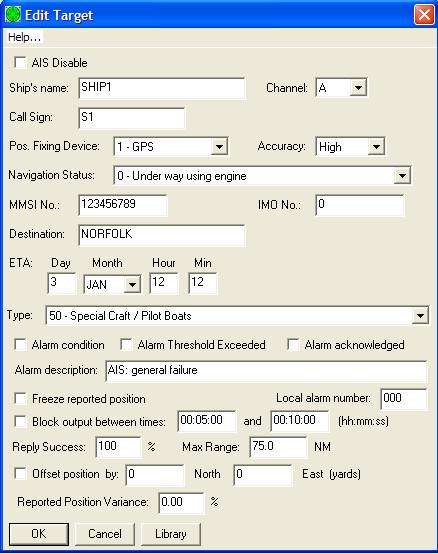
Automatic Identification System (AIS)
Key Features
- AIS message generator developed in conjunction with the US Coast Guard
- Integrated directly into the MaST user interface
- Output via serial (RS232/RS422), network UDP, or network TCP
- Compliant with ITU-R M.1371-5, IEC 61993-2, IEC 61162-1, and NMEA-0183 standards
- Simulation exercises support up to 1000 AIS targets
- Library feature for quick storage and retrieval of AIS information, editable offline
- CSV import for entering large numbers of targets
- Receives AIS messages via serial or network, with logging to a dedicated message log window and file
- Separate logging for SRM and Normal text messages
- Supports Class A and Class B (SO/CS mode) AIS equipment types
- Supports AIS for aircraft (SAR position reporting), Aids-to-Navigation (ATON), and Base Stations
- Automatic position reporting intervals based on vessel speed and course changes
- Instructor-controlled AIS failure simulation (erroneous data, missed updates, position errors)
- Multiple ownship configurations, each with independent AIS output
- Sends and receives message types 1, 4, 5, 6, 8, 9, 12, 13, 14, 18, 19, 21, 24, 25, 26, 27
- Receives message types 2, 3, 7, 11, 20

